
By Sheikh Elevator World Technical Team | Updated May 2026 | 14 min read
Every time someone steps into a lift, their safety depends entirely on a set of precisely engineered components working together in the background. Most building owners and residents never think about these systems — until something goes wrong.
At Sheikh Elevator World, we have been installing and maintaining lifts across Dhaka for 10+ years, in areas including Mirpur, Gulshan, Uttara, Banani, and Azimpur. In that time, we have seen firsthand that the difference between a safe lift and a dangerous one almost always comes down to the quality and condition of its elevator safety components.
This guide covers every major safety component in a modern lift — what it does, why it matters, and what to look for when evaluating your building’s elevator system.
What Are Elevator Safety Components?
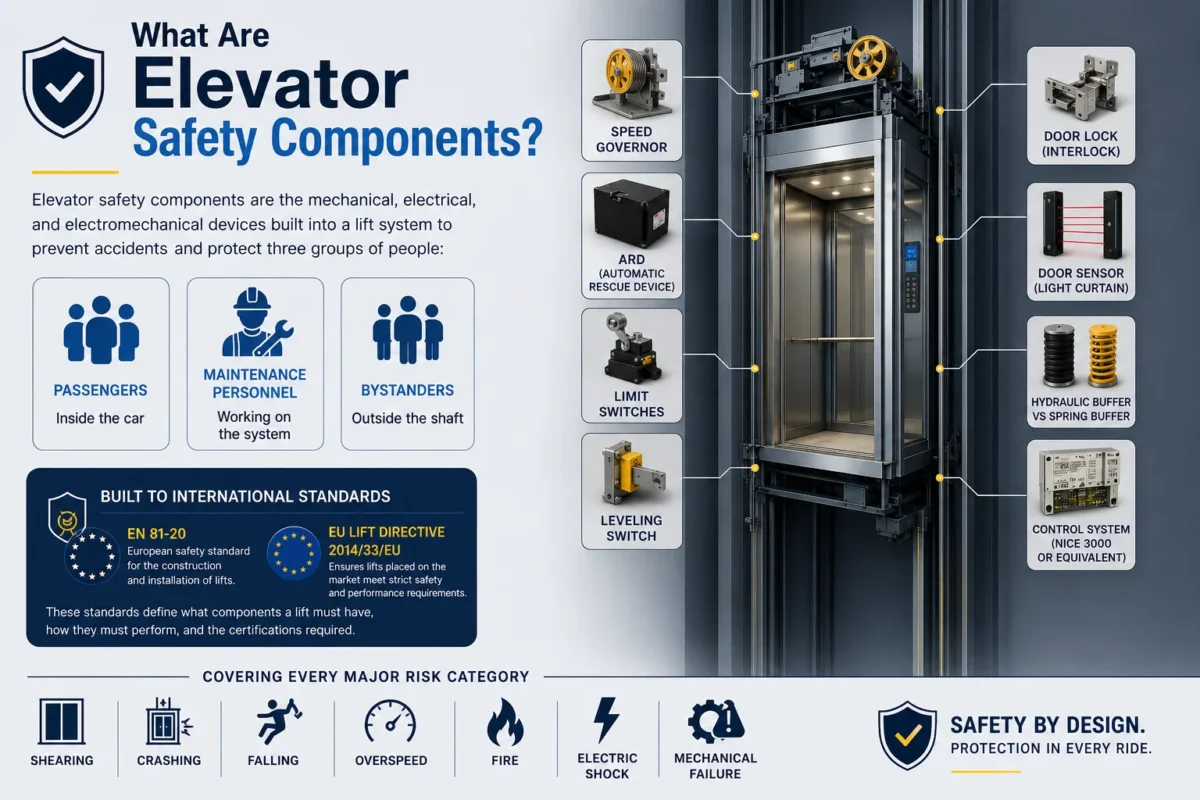
Elevator safety components are the mechanical, electrical, and electromechanical devices built into a lift system to prevent accidents and protect three groups of people: passengers inside the car, maintenance personnel working on the system, and bystanders outside the shaft.
International standards such as EN 81-20 (the European lift safety standard followed by reputable manufacturers in Bangladesh) and the EU Lift Directive 2014/33/EU define exactly which components a lift must have, how they must perform, and what certifications they require. A lift that meets these standards has safety devices covering every major risk category: shearing, crashing, falling, overspeed, fire, electric shock, and mechanical failure.
The core safety components in any modern passenger lift are:
- Speed Governor (Overspeed Governor)
- Automatic Rescue Device (ARD)
- Limit Switches (Terminal and Final)
- Leveling Switch
- Hydraulic Buffer Spring
- Door Lock (Landing Door Interlock)
- Door Sensor (Light Curtain / Photocell)
- NICE 3000 Control Panel (or equivalent)
Below, we cover each one in detail.
Why Elevator Safety Systems Matter
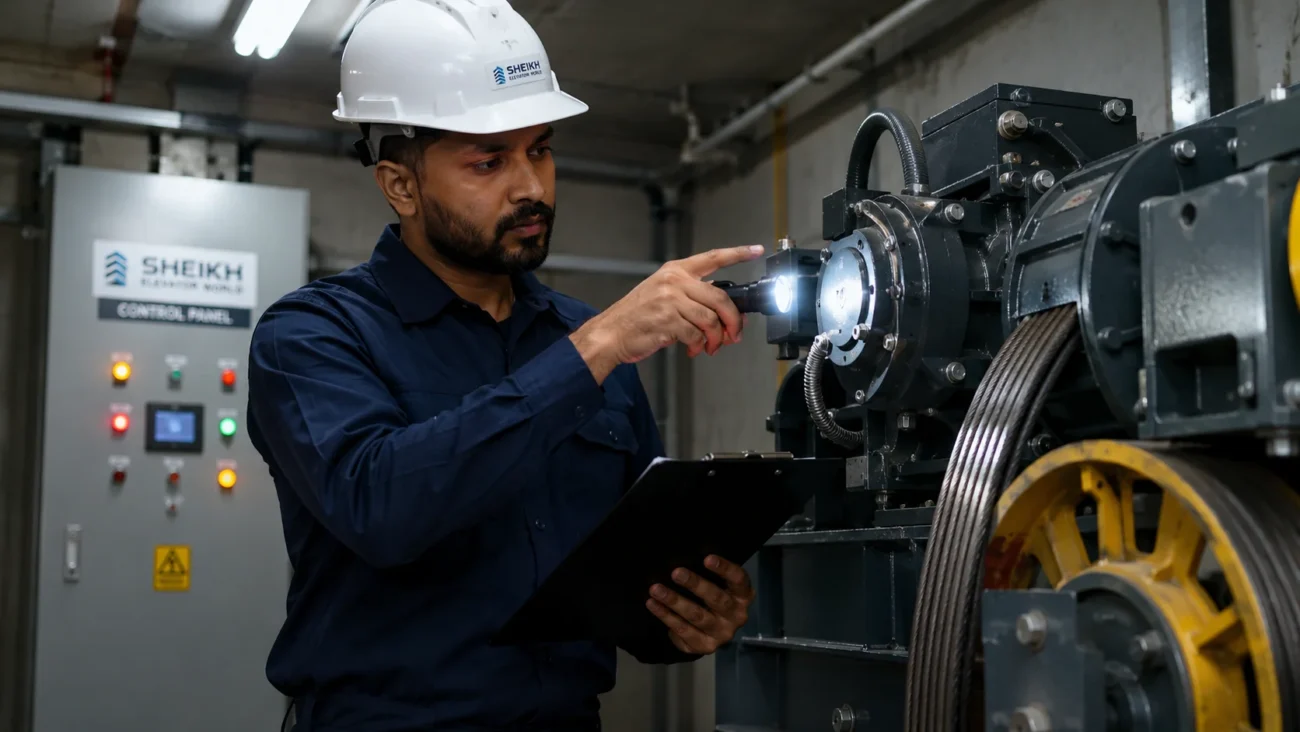
Before diving into individual components, it’s worth understanding the stakes. Elevator failures are rare in well-maintained systems — but when they occur, the consequences are severe. According to elevator industry safety data, the most common causes of lift accidents globally are door malfunctions, uncontrolled car movement, and overspeed events. All three are preventable with properly functioning safety components.
In Bangladesh, the Bangladesh National Building Code (BNBC) requires that all lifts installed in commercial and residential buildings meet established safety standards. Building owners who install substandard lifts or skip regular maintenance expose themselves to legal liability — and more importantly, to the risk of serious injury to residents and guests.
In our experience servicing lifts across Dhaka, the buildings with the fewest problems are those whose owners treat elevator safety components not as a one-time installation cost, but as an ongoing maintenance responsibility. A component that costs a few thousand taka to replace when worn can prevent an accident that causes hundreds of thousands in damages — or worse.
Speed Governor — The Overspeed Guardian
The speed governor is the component that detects when a lift is moving too fast and triggers the mechanical braking system to stop the car. It is the first line of defense against one of the most dangerous elevator failure modes: uncontrolled descent.
How the Speed Governor Works
The governor operates entirely on mechanical principles — centrifugal force. As the governor’s sheave spins in proportion to the car’s speed, centrifugal weights fly outward. When the car exceeds 115% of its rated speed, these weights trigger a latch that grips the governor rope, stopping it. This rope tension then activates the mechanical safety gear (parachute system) on the car frame, clamping it to the guide rails.
Crucially, this system works without any electrical input. Even in a total power failure, the governor and safety gear will stop the car.
Our in-depth guide covers:
- How the governor rope, pulley, and safety gear work together
- The 6-step overspeed response sequence explained simply
- Common governor failure reasons specific to Dhaka buildings
- Warning signs your lift governor needs immediate attention
- When repair is enough — and when full replacement is the safer choice
Modern installations also require ascending car overspeed protection — meaning the governor system must detect and respond to dangerous upward movement, not just downward. This is a relatively recent addition to the standard and is now mandatory in new installations.
Read the full guide: How a Lift Speed Governor Works →
Automatic Rescue Device (ARD) — Preventing Passenger Entrapment
The Automatic Rescue Device (ARD) is a battery-powered system that moves a stranded lift car to the nearest floor landing and opens the doors, allowing passengers to exit safely after a power failure.
Without an ARD, passengers trapped between floors must wait for a technician to manually release the brake and wind the car to a floor — a process that can take 30 minutes to several hours. With an ARD, the rescue happens automatically within seconds of a power outage.
How the ARD Works
When mains power fails, the ARD’s battery bank immediately takes over. It calculates which floor landing is closest, drives the motor at reduced speed to reach it, and triggers the door-open command once level. The entire process typically completes in under 60 seconds.
Why it matters for Dhaka buildings: Load-shedding and power fluctuations are a daily reality in many parts of Dhaka. Buildings without ARD-equipped lifts frequently receive distress calls from trapped passengers during outages. An ARD eliminates this problem entirely.
See our detailed guide: What is ARD in Elevator? Working Principle, Cost & Safety Guide
Limit Switch — Preventing Overtravel
Limit switches are safety devices that cut power to the lift motor when the car approaches the top or bottom of the shaft, preventing it from crashing into the overhead structure or pit floor.
Every lift has at least two sets of limit switches: terminal limit switches that slow the car as it approaches the end of its travel range, and final limit switches that cut all power if the car somehow passes the terminal switches.
Terminal vs Final Limit Switches
| Type | Function | What Happens If Triggered |
|---|---|---|
| Terminal Limit Switch | Detects normal end-of-travel | Slows and stops car normally |
| Final Limit Switch | Detects overtravel past terminal | Cuts all power; requires manual reset |
Final limit switches are a last-resort safety measure. If one triggers during normal operation, it indicates a serious fault in the drive system and the lift must be taken out of service immediately for inspection.
Leveling accuracy: Limit switches also interact with the leveling system to ensure the car floor aligns precisely with the landing floor — typically within ±10mm. Poor leveling is not just inconvenient; a gap between the car and the landing is a tripping hazard, particularly for elderly passengers and wheelchair users.
👉 Read the full guide: Elevator Limit Switch — How It Works & Safety Role
Leveling Switch — Precision Floor Alignment
The leveling switch ensures the lift car stops with its floor exactly level with the building floor at each landing, preventing trip hazards and enabling smooth entry and exit.
How Leveling Works
As the car approaches a floor, the leveling switch (typically a magnetic or optical sensor reading a vane or magnet on the shaft wall) detects the exact landing zone. It signals the controller to switch from high speed to leveling speed, then cuts drive power at the precise moment the car is flush with the floor.
If the car drifts slightly after stopping — due to rope stretch from passengers boarding — a re-leveling function moves the car back into the level zone with the doors still open. This is a standard feature in modern controllers.
Why leveling accuracy matters: In buildings with heavy traffic (hospitals, shopping centres, office towers), a poorly leveling lift causes constant minor injuries from passengers catching their feet on the floor gap. It also accelerates wear on door sill components.
👉 Read the full guide: Elevator Leveling Switch — Floor Alignment Safety Guide
Hydraulic Buffer Spring — The Last Line of Defense at the Pit
Buffers are energy-absorbing devices installed at the bottom of the lift shaft (and sometimes the top) that stop the car or counterweight safely if it travels beyond its normal limits and reaches the end of the pit.
Think of them as the elevator’s crash cushion. If every other safety system fails and the car plunges into the pit, the buffer absorbs the kinetic energy and brings the car to a controlled stop rather than a sudden impact.
Types of Buffers
Energy Accumulation Buffers (Spring Buffers): Used for lifts travelling at 1 m/s or less. These are essentially heavy-duty springs that compress under the car’s weight and push back. The standard minimum stroke for spring buffers is 65 mm, calculated as 0.135 × v² (where v is rated speed in m/s).
Energy Dissipation Buffers (Hydraulic Buffers): Required for lifts travelling faster than 1.6 m/s. Hydraulic buffers use a piston moving through oil to absorb energy progressively — much smoother and better suited to high-speed lifts. After impact, the buffer automatically resets as the car is lifted off it. A safety contact confirms the buffer has returned to its extended position before the lift can be operated again.
Buffer sizing requirements (EN 81-20): Buffers must be designed to handle a static load of between 2.5 and 4 times the combined mass of the car and its rated load. This safety margin ensures the buffer works even in worst-case overload conditions.
In our installation projects across Dhaka, we always verify that buffer specifications match the actual lift speed and load — a common shortcut taken by low-cost installers is to fit undersized buffers that technically look correct but do not meet the stroke and load requirements.
👉 Read the full guide: Elevator Buffer Spring — How It Protects Lift Safety
Door Lock Safety — Keeping the Shaft Closed
The door lock (landing door interlock) is an electromechanical device that prevents the lift from moving unless every landing door on every floor is fully closed and locked, and prevents landing doors from being opened unless the car is present at that floor.
This is one of the most critical safety components in any lift. Without a functioning door lock, two catastrophic scenarios become possible: a passenger could fall into the open shaft when no car is present, or the car could move with a door open.
How Door Locks Work
Each landing door has an interlock with two functions:
- A mechanical bolt that locks the door from the outside — it can only be released when the car is at that floor and triggers an unlocking cam
- An electrical contact in the safety circuit — the lift controller receives a “door closed and locked” signal from every floor before allowing movement
If any single door contact opens during operation, the lift stops immediately — no delay, no warning. This “positive separation” requirement means the contact physically breaks even if the contacts have welded together from arcing.
Emergency unlocking: Every landing door must also have a provision for emergency unlocking with a special triangular key, allowing trained personnel to open any floor door to access the shaft for rescue operations.
👉 Read the full guide: Elevator Door Lock Safety — How Interlocks Work
Door Sensor — Detecting Obstructions
Door sensors (light curtains or photocells) detect people or objects in the doorway and prevent the doors from closing on them, reversing the door travel immediately if an obstruction is detected.
Modern lifts use multi-beam light curtains — a grid of infrared beams across the door opening that can detect a hand, foot, or thin object like an umbrella. If any beam is broken while the doors are closing, the doors immediately reverse to fully open.
Light Curtain vs Photocell
| Type | Coverage | Best For |
|---|---|---|
| Single Photocell | One beam across mid-height | Basic protection, older installations |
| Multi-beam Light Curtain | 30–50+ beams, full door height | Comprehensive protection, current standard |
| 3D Sensor | Full volumetric detection | Premium installations, high-traffic buildings |
Older lifts with only a single photocell have a known blind spot — a small child or low-profile object can pass under the beam without triggering the reversal. For any lift installed or upgraded today, multi-beam light curtains are the minimum acceptable standard.
Door sensors vs door safety edges: Some older lifts use a rubber safety edge on the door leading edge — a mechanical device that triggers reversal on physical contact. Light curtains are preferred because they prevent contact entirely rather than responding after it occurs.
👉 Read the full guide: Elevator Door Sensor — Light Curtain vs Photocell Guide
NICE 3000 Control Panel — The Brain of the System
The NICE 3000 (and its successors) is an integrated lift controller from STEP Electric that manages all aspects of lift operation — motor drive, door control, floor selection, safety monitoring, and fault diagnostics — from a single unified system.
It is one of the most widely used lift controllers in Bangladesh and across South Asia, valued for its reliability, ease of commissioning, and comprehensive safety integration.
What the NICE 3000 Controls
- Motor drive (VVVF): Variable voltage variable frequency control for smooth, energy-efficient acceleration and deceleration
- Door control: Timing, sensor integration, re-opening logic
- Safety circuit monitoring: Real-time monitoring of all safety contacts — any fault is logged with a fault code
- Floor leveling: Precise stopping at each landing
- Load weighing integration: Receives signals from overload contacts and adjusts operation accordingly
- ARD integration: Coordinates with the automatic rescue device during power failure
- Remote monitoring: Modern versions support remote diagnostics, allowing technicians to read fault codes without attending site
Why the controller matters for safety: All the physical safety components described in this guide ultimately report to the controller. A fault in a door lock, limit switch, or buffer contact appears as an input to the controller, which then decides whether to stop the car, log a fault, or trigger an alarm. A high-quality controller with well-designed safety logic is what ties the entire system together.
👉 Read the full guide: NICE 3000 Elevator Control Panel — Complete Guide
How These Components Work Together as a System
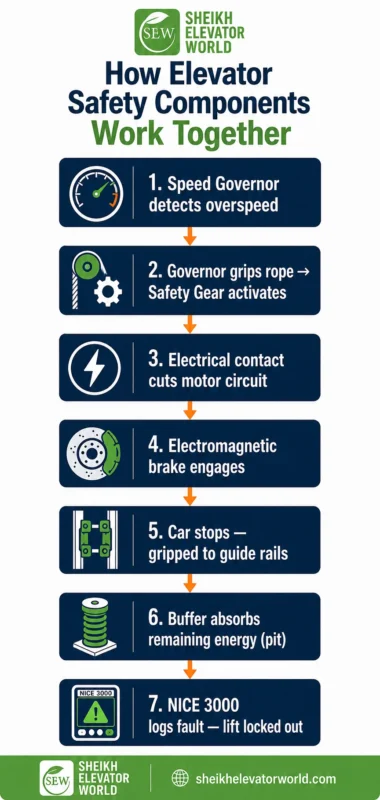
Individual safety components only tell part of the story. Their real power comes from how they integrate into a complete safety chain.
Consider a typical emergency scenario: the car begins to descend faster than normal due to a brake fault.
- The speed governor detects speed exceeding 115% of rated speed
- The governor grips its rope, activating the mechanical safety gear on the car frame
- Simultaneously, the governor electrical contact cuts the motor circuit
- The electromagnetic brake on the motor engages (it locks when de-energized)
- The car comes to a stop, gripped to the guide rails by the safety gear
- If the car had somehow reached the pit, the buffer would absorb the remaining energy
- The NICE 3000 controller logs the fault and prevents operation until a technician resets the system
Every step in this chain is a layer of redundancy. No single component failure should result in passenger injury — the next component in the chain catches it.
This is why regular maintenance matters so much. A governor that trips correctly but whose electrical contact has corroded provides partial protection. A door lock that mechanically bolts but whose electrical contact has welded shut provides false security. The system is only as strong as its weakest component.
Frequently Asked Questions
How often should elevator safety components be inspected?
All safety components should be inspected by a qualified technician at least every six months, with a full safety test — including governor tripping and buffer testing — performed annually. In Bangladesh, high-use commercial lifts in buildings such as hospitals, shopping centres, and offices benefit from quarterly inspections given the higher cycle counts.
What is the difference between a safety contact and a regular switch?
A safety contact must operate by positive mechanical separation — meaning the contacts physically break apart regardless of whether they have been welded by arcing. A regular switch may rely on spring pressure to open the contacts. Only positive-separation contacts are permitted in elevator safety circuits under EN 81-20.
Can old lifts be upgraded with modern safety components?
Yes, in most cases. Retrofitting a modern light curtain, ARD, or updated controller onto an older lift is a cost-effective way to significantly improve safety. Sheikh Elevator World offers safety audits that identify which components in an existing lift are below current standards and recommend a prioritised upgrade plan.
What causes elevator door faults — the most common type of call-out?
Door faults are caused by worn door rollers or tracks (causing misalignment), dirty or misaligned light curtain sensors, corroded or worn door lock contacts, and damaged sill guides. Most door issues are preventable with regular cleaning and lubrication as part of a scheduled maintenance programme.
Is the NICE 3000 suitable for all lift types?
The NICE 3000 series covers most passenger lift configurations — traction lifts up to 6 m/s, MRL (machine-room-less) lifts, and duplex/group control. For very high-speed lifts above 6 m/s or specialist cargo lifts, a different controller platform would typically be specified. Our team can advise on the right controller for your specific installation.
What happens if a buffer is struck during operation?
If a hydraulic buffer is struck, it must not be returned to service until a qualified technician has inspected it and confirmed it has returned fully to its extended position (verified by the buffer return electrical contact). Buffer impact indicates an overtravel event, which requires investigation into the underlying cause — typically a limit switch fault, drive system error, or brake wear.
Conclusion: Don’t Wait for a Fault to Think About Safety
Elevator safety components are not an optional extra — they are the foundation of every safe lift installation. Understanding what each component does helps building owners ask the right questions, recognise warning signs, and make informed decisions about maintenance and upgrades.
If your building’s lift is showing any of the following signs, it is time for a professional safety inspection:
- Doors that close slowly, reverse unexpectedly, or do not fully seal
- The car stopping slightly above or below the floor level
- Unusual noises during travel (grinding, clunking, or rope slapping)
- The lift moving while a door is open, even momentarily
- Frequent tripping of circuit breakers or fault resets needed to restore operation

Sheikh Elevator World has been serving Dhaka’s residential and commercial buildings for 15 years. Our team of certified technicians installs, maintains, and repairs lifts across Mirpur, Gulshan, Uttara, Banani, and Azimpur.
📞 Call us: 01795244154
🌐 Website: sheikhelevatorworld.com
📍 Address: 229/1, North Ibrahimpur, Mirpur-14, Dhaka 1206
Contact Sheikh Elevator World for a safety inspection of your building’s lift.
Sheikh Elevator World service support
Sheikh Elevator World provides elevator installation, maintenance, repair, AMC, modernization, safety audit, and spare-parts support for buildings in Dhaka and Bangladesh.
- 10+ years of elevator service experience.
- Office: 229/1, North Ibrahimpur, Mirpur-14, Dhaka 1206, Bangladesh.
- Service areas include Mirpur, Gulshan, Uttara, Banani, Azimpur, Dhaka, and nearby areas.